Quick answer: If you own an iPhone 12 or later, use a Qi2 charger. You will charge at 15W instead of 7.5W, the magnetic snap means you never have to adjust the phone on the pad, and any Qi2 charger works, so you do not need to pay Apple's MagSafe premium. Qi2 also gives Android phones a consistent 15W. Older phones still charge on Qi2, just at the slower Qi1 speed.
Want magnetic charging that travels with you?

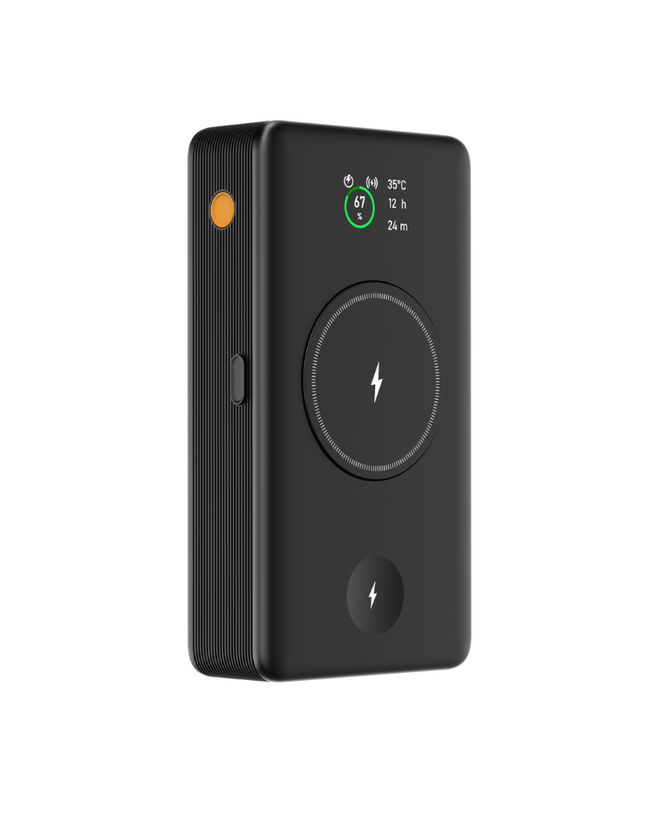
A 15W magnetic pad on the back for your iPhone, plus 100W USB-C for a laptop at the same time.
$199 $169Save $30
★★★★★ 4.95 from 21 reviews · Free shipping over $99 · 30-day returns
Just want the magnetic snap? SlimCharge, $59
Wireless charging has gone from a novelty to a genuine daily driver for most iPhone and Android users. But the terminology has become confusing fast. Qi, Qi2, MagSafe, 15W, 50W — the numbers and brand names get thrown around without much explanation of what actually matters for how fast your phone charges.
This guide cuts through the noise. I will explain what each standard is, how they differ, and which one you actually need based on what you own.
The Foundation: What Is Qi?
Qi (pronounced "chee") is the universal wireless charging standard developed by the Wireless Power Consortium. Almost every wireless charger and wireless charging-capable phone sold since 2015 uses Qi. It is the reason you can put any modern iPhone or Android phone on almost any wireless charging pad and have it charge.
The original Qi standard, now referred to as Qi1, tops out at around 7.5W for iPhones and 10-15W for Android devices depending on the manufacturer's proprietary fast-charge protocol. It works, but it is slow compared to wired charging.
Qi2: The Upgrade That Changes Everything
Qi2 was introduced in 2023 by the Wireless Power Consortium, developed in collaboration with Apple. It does two things that Qi1 cannot:
1. Magnetic alignment. Qi2 pads include a ring of magnets that snaps your phone into the exact optimal position for wireless charging. On Qi1, if your phone is even slightly off-centre on the pad, charging efficiency drops significantly. Qi2 eliminates this by physically locking the phone in place.
2. Higher speed. Qi2 supports up to 15W for compatible devices, compared to 7.5W for Qi1 on iPhone. For Android devices, Qi2 delivers a consistent 15W regardless of the manufacturer, which was not possible with Qi1 where speeds varied by brand.
Qi2 is backwards compatible with Qi1 devices. A Qi2 charger will charge any Qi1 phone, just at the lower Qi1 speed.
MagSafe: Apple's Proprietary Version
MagSafe is Apple's own wireless charging system, introduced with iPhone 12 in 2020. It uses the same magnetic alignment ring as Qi2 (in fact, Qi2 was built on the MagSafe standard), but MagSafe is exclusive to Apple devices and Apple-certified accessories.
On a genuine Apple MagSafe charger, iPhone 12 and later charges at up to 15W. On a Qi2 charger (non-Apple certified), the same iPhones charge at 15W. For practical purposes, Qi2 and MagSafe deliver the same charging speed on iPhone. The difference is that MagSafe accessories can also communicate with iOS for features like battery percentage display and optimised charging, while Qi2 accessories cannot.
Qi vs Qi2 vs MagSafe: Side by Side
| Qi1 | Qi2 | MagSafe | |
|---|---|---|---|
| Max speed on iPhone | 7.5W | 15W | 15W |
| Max speed on Android | Up to 15W (varies by brand) | 15W (consistent) | Not compatible |
| Magnetic alignment | No | Yes | Yes |
| Works with all phones | Yes | Yes (backwards compatible) | iPhone 12 and later only |
| iOS battery display | No | No | Yes (Apple certified only) |
What About the 50W and 67W Wireless Chargers?
You may have seen Samsung, OnePlus, or Xiaomi advertising wireless charging at 50W or even higher. These speeds are real, but they use proprietary protocols that only work between that brand's phone and that brand's charger. A Samsung 50W wireless charger will not charge an iPhone at 50W. It will charge it at standard Qi speeds.
These high-speed proprietary wireless standards are separate from the Qi/Qi2/MagSafe ecosystem. They are faster, but they lock you into a single brand's ecosystem for both the charger and the phone.
Which Standard Do You Actually Need?
The answer depends on what phone you own:
- iPhone 12 or later: Get a Qi2 or MagSafe charger. You will charge at 15W instead of 7.5W, and the magnetic snap means the phone is always perfectly positioned. The difference in daily use is noticeable.
- Android (Samsung, Google Pixel, etc.): Qi2 gives you consistent 15W on any compatible charger. If you own a Samsung flagship, the proprietary Samsung fast wireless charging pad will be faster, but only when used with a Samsung charger.
- Older iPhone (11 or earlier) or budget Android: A standard Qi1 charger is all you need. Qi2 will work but you will not get the speed benefit.
Where We Put Qi2, and Why
We build Qi2 into our power banks rather than selling desk pads, because a pad only helps when you are sitting at the desk it is on. A magnetic bank charges your phone at the same 15W while you are moving — and unlike a pad, it also holds a reserve for when there is no outlet at all.
Qi2 that travels with you

Flash Pro Plus — 25,000mAh
A 15W Qi2 MagSafe-compatible pad on the back, so the iPhone snaps on and charges at full wireless speed — while 100W of USB-C on the other side runs a laptop at the same time.
$199 $169 View

SlimCharge — the pocket option
Snaps to the back of the phone and stays there, turning the phone into its own charging station. The most portable wireless charging we make, and the cheapest way to get the magnetic snap.
$59 View
Charging a laptop too? Flash Pro Ultra carries the same 15W magnetic pad alongside 140W USB-C in and out — $329.
Shop Chargeasap wireless charging power banks
Vinson is Cofounder at Chargeasap, an Australian charging hardware company that has run 14 crowdfunding campaigns on Kickstarter and Indiegogo and shipped to more than 108,000 customers since 2016. He has personally tested every wireless charging product in this guide.
FAQ
What is the difference between Qi and Qi2?
Qi1 is the original wireless charging standard, topping out at 7.5W for iPhones and up to 15W for some Android devices. Qi2 adds magnetic alignment (so your phone snaps into the correct position automatically) and delivers a consistent 15W for all compatible devices. Qi2 is backwards compatible with Qi1 phones.
Is Qi2 the same as MagSafe?
Qi2 was developed based on Apple's MagSafe standard and delivers the same 15W charging speed on iPhone. The difference is that MagSafe is Apple-certified and enables iOS features like battery percentage display, while Qi2 is an open standard that works with both iPhone and Android at 15W.
Does Qi2 work with Samsung?
Yes. Qi2 delivers 15W on compatible Samsung devices. However, Samsung's proprietary fast wireless charging (up to 15W on some models, higher on others) requires a Samsung-branded charger to reach its maximum speed. A Qi2 charger will charge Samsung phones at 15W consistently.
Do I need to buy Apple's MagSafe charger for an iPhone?
No. A Qi2 charger delivers the same 15W to an iPhone 12 or later as a genuine Apple MagSafe charger. Apple certification adds iOS features such as battery percentage display and optimised charging, but not speed.
What is the fastest wireless charging available?
For iPhone, 15W via MagSafe or Qi2 is the maximum. For Android, some brands offer proprietary wireless charging at 50W or higher, but only when using that brand's own charger and phone together. Across all devices and chargers, Qi2 at 15W is the fastest universal standard available in 2026.