Written by Vinson, Cofounder at Chargeasap, with 10 years building and testing portable chargers.
Most people buy a power bank based on the largest mAh number they can find at their budget. That is the wrong way to choose. After a decade of building power banks and talking to tens of thousands of customers, I can tell you that the number that actually determines whether a power bank is useful for you is not the capacity. It is the output wattage.
This guide walks through every spec that matters, in the order you should consider them.
Step 1: Know What You Are Charging
Before looking at any power bank spec, write down every device you want to charge from it. Then find the wattage each device needs:
| Device | Wattage Needed for Fast Charging |
|---|---|
| iPhone 15 / 16 | 27W |
| Samsung Galaxy S24 | 25W |
| iPad Pro (M4) | 45W |
| MacBook Air (M3) | 30-67W |
| MacBook Pro 14-inch | 67-96W |
| MacBook Pro 16-inch | 140W |
| Most Windows ultrabooks | 45-65W |
| Gaming laptops | 100-140W |
The power bank you choose must have at least one port that delivers the wattage your highest-demand device needs. If the power bank's maximum single-port output is lower than your laptop's charging requirement, the laptop will charge slowly or not at all.
Step 2: Capacity and What the mAh Number Actually Means
mAh (milliamp hours) measures how much energy the power bank stores. But the number on the box is measured at the battery's internal voltage (typically 3.7V), not at the 5V or 9V your device actually receives. This means a 25,000mAh power bank does not deliver 25,000mAh to your phone.
A rough rule of thumb: multiply the mAh by 0.6 to get the effective capacity at USB output voltage. A 25,000mAh power bank delivers roughly 15,000mAh to your devices in practice, accounting for conversion losses.
For reference:
- iPhone 16 battery: ~3,500mAh, so a 25,000mAh power bank charges it roughly 4 times
- MacBook Air (M3): ~52.6Wh, so a 25,000mAh (92.5Wh) power bank charges it roughly once fully
- MacBook Pro 16-inch: ~99.6Wh, so a 25,000mAh power bank charges it to about 80%
Step 3: Airline Safety
If you travel with a power bank, this is non-negotiable. Most airlines follow the IATA lithium battery rules: power banks up to 100Wh are permitted in carry-on baggage without approval. Power banks between 100-160Wh require airline approval. Power banks above 160Wh are not permitted on passenger aircraft.
To convert mAh to Wh: multiply mAh by the battery voltage (usually 3.7V) and divide by 1000. A 25,000mAh power bank at 3.7V = 92.5Wh, which is safely under the 100Wh limit. Our Flash Pro Ultra (25,000mAh / 90.75Wh) and Flash Pro Plus (25,000mAh / 92.5Wh) are both under the 100Wh limit, so most airlines allow them in carry-on bags.
Step 4: Number of Ports and Simultaneous Charging
If you only charge one device at a time, port count does not matter much. If you want to charge a laptop and a phone simultaneously, you need a power bank with at least two ports and enough total wattage to power both at useful speeds.
Watch out for power banks that advertise a high single-port wattage but have a low total output. A power bank with a 100W USB-C port and 65W total output will throttle the 100W port to 65W the moment a second device is connected. The spec that matters for simultaneous charging is total output wattage, not single-port maximum.
Step 5: Wireless Charging
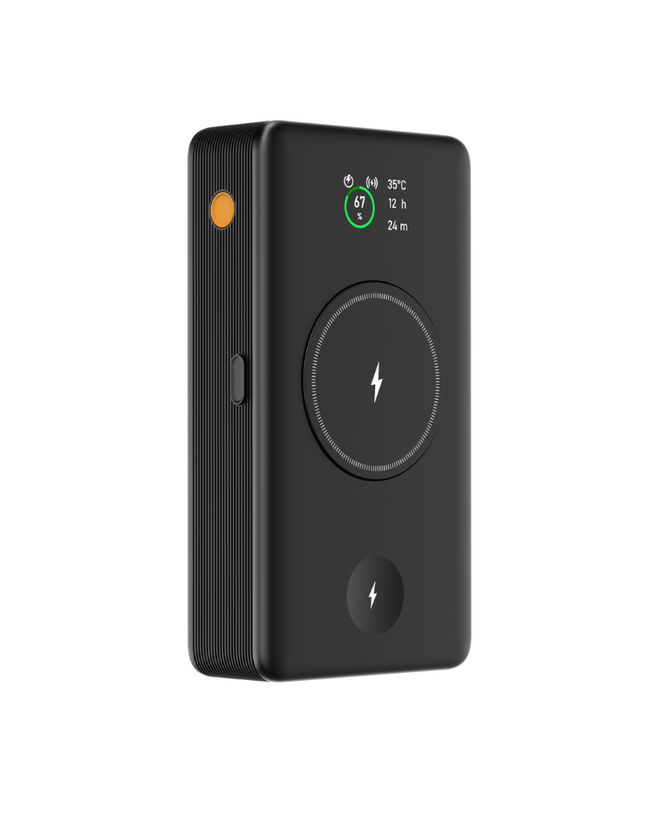
If you own an iPhone 12 or later, a power bank with a Qi2 or MagSafe-compatible wireless charging pad lets you charge your phone without a cable. This is genuinely useful when you want to charge your phone on a desk or in a bag without routing a cable.
Not all wireless charging on power banks is equal. Look for 15W Qi2 output specifically. Lower-wattage wireless pads (5W or 7.5W) charge too slowly to be practical for anything other than overnight top-ups.
Step 6: Recharge Speed
A common oversight: how fast can the power bank itself recharge? A 25,000mAh power bank recharged via a 20W phone charger takes 10+ hours to refill. The same power bank with a 140W input takes about 70 minutes. If you travel frequently and need the power bank ready by morning, the input wattage matters as much as the output.
Which Chargeasap Power Bank Is Right for You
| Flash Pro Ultra | Flash Pro Plus | PocketPower Pro | SlimCharge | |
|---|---|---|---|---|
| Capacity | 25,000mAh | 25,000mAh | 10,000mAh | 5,000mAh |
| Max output | 140W USB-C | 100W USB-C | 65W USB-C | 15W wireless |
| Charges laptop? | Yes (up to MBP 16") | Yes (up to MBP 14") | Yes (MacBook Air) | No |
| Wireless charging | 15W Qi2 + Watch | 15W Qi2 + Apple Watch |
15W Qi2 + Apple Watch |
15W MagSafe |
| Airline safe | Yes | Yes | Yes | Yes |
| Best for | Heavy travellers, MacBook Pro 16" users | MacBook Air/Pro 14" + Apple Watch users | Day trips, light travel | iPhone top-ups on the go |
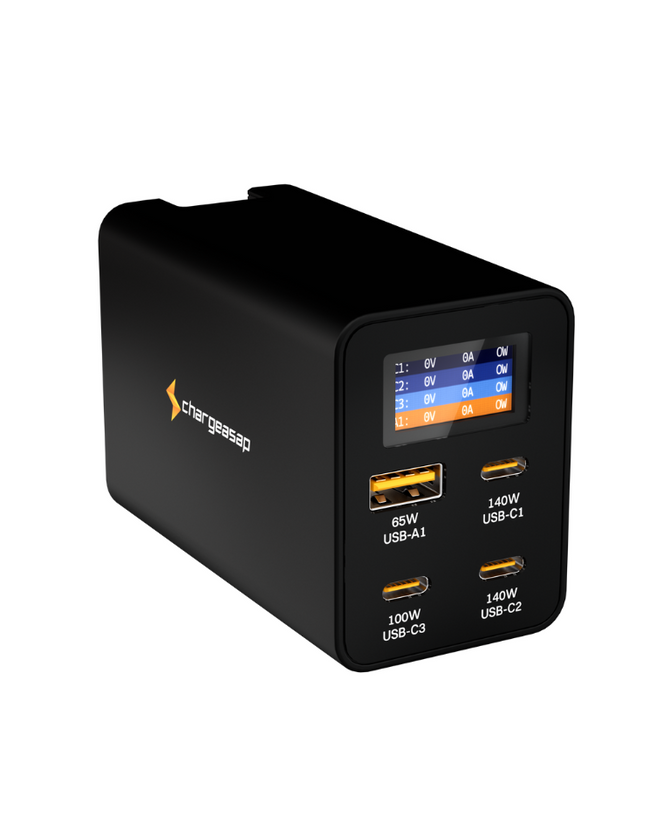
"Port C1 can charge a 16” MacBook Pro while you are working it hard. After all, 140W is the same as its supplied charger. This leaves you with three remaining ports and over 100W on tap for other things besides your laptop, phone and watch."
- Grover F., Flash Pro Ultra owner, United States
Shop the full Chargeasap power bank range here.
Vinson is Cofounder at Chargeasap, an Australian charging hardware company that has run 14 crowdfunding campaigns on Kickstarter and Indiegogo and shipped to more than 108,000 customers since 2016. He has personally tested every power bank in this guide.
FAQ
How many mAh do I need in a power bank?
For charging phones only, 10,000mAh is enough for 2-3 full charges of a modern smartphone. For charging a laptop, you need at least 20,000mAh. For a MacBook Pro 16-inch, a 25,000mAh power bank will charge it to about 80%. Capacity matters, but the output wattage determines whether your laptop gets all the power it can take.
Can a power bank charge a laptop?
Yes, if the power bank has a USB-C port with Power Delivery (PD) output at the correct wattage. A MacBook Air needs at least 30W. A MacBook Pro 14-inch needs at least 67W. A MacBook Pro 16-inch needs a 140W port to charge at its maximum rate. Check the power bank's maximum single-port output before buying.
Are power banks allowed on planes?
Power banks up to 100Wh are permitted in carry-on baggage on most airlines without prior approval. A 25,000mAh power bank at 3.7V equals 92.5Wh, which is under the limit. Power banks must be carried in the cabin, not checked baggage. Always check with your specific airline before travelling.
What is the difference between a power bank and a portable charger?
They are the same thing. "Power bank" and "portable charger" are interchangeable terms for a battery pack that stores energy and charges devices via USB. The term "power bank" is more common in Asia and Australia; "portable charger" is more common in the US and UK.