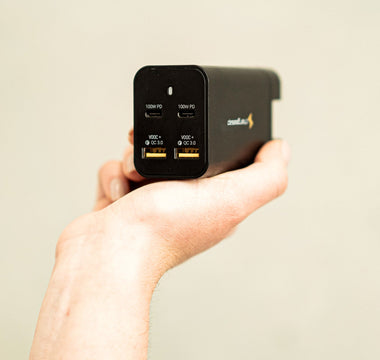

Quick answer: One specification separates these two and it is buried in both product pages. The Anker Prime 250W delivers 140W on a single port. Its remaining USB-C ports cap at 100W. Zeus 280W is built to run two ports at up to 140W. If you charge one laptop, either will do and the Anker is cheaper. If you charge two, the Anker cannot do it at any price.
Charging two laptops?

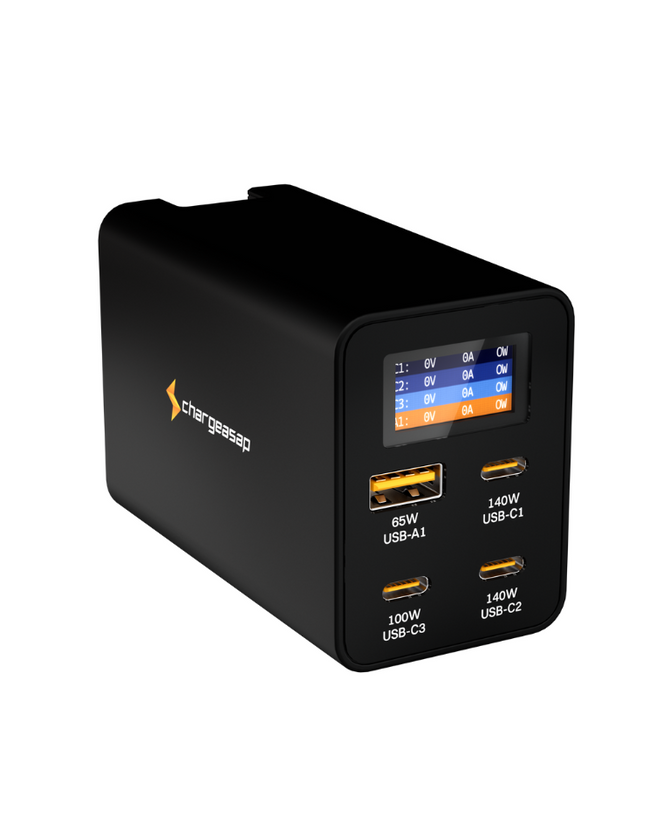
Two ports that each reach 140W, a live wattage display, and 380g against the Anker's 640g.
$189
Backed by 14,000+ crowdfunding supporters · Free shipping over $99 · Plugs for 150+ countries included
Only one laptop? Omega 200W, $139
The One Specification That Separates Them
Both chargers advertise 140W. Only one of them advertises it twice.
On the Anker Prime 250W, port C1 delivers up to 140W. C2, C3 and C4 cap at 100W each. So it charges one large laptop at up to 140W. Connect a second 140W laptop and that one gets 100W at best, which on a 16 inch MacBook Pro under load can mean the battery holds steady rather than climbing.
Zeus 280W is built around two ports that can each deliver up to 140W when the total allows it. Two large laptops, or a laptop and a high-draw portable monitor, both charge properly.
This is not a price difference. It is a capability difference. If two devices at 140W is what you need, the Anker is not a cheaper way to get it, it is not a way to get it.
The Specs, Side by Side
| Chargeasap Zeus 280W | Anker Prime 250W | |
|---|---|---|
| Second port maximum | 140W | 100W |
| Total output | 280W | 250W |
| Volume | 231cm³ | 395cm³ |
| Weight | 380g | 640g |
| Travel plugs, 150+ countries | Included | Not included |
| Highest single port | 140W | 140W |
| Live wattage display | OLED | 2.26" LCD with dial |
| Ports | 3 USB-C, 1 USB-A | 4 USB-C, 2 USB-A |
| Price | $189 | $149.99 |
Forty Percent Less Bag
Zeus occupies 231cm³ against Anker's 395cm³ and weighs 380g against 640g. Roughly 40 percent less space and 40 percent less weight, while delivering 30W more.
On a desk that is close to irrelevant. In a bag it is the entire argument. 640g is heavier than a large phone and takes the volume of a paperback, and it is the item you notice when the bag is already full.
What the Price Gap Actually Is
$189 against $149.99 looks like a $39 difference. It is smaller than that for anyone who travels.
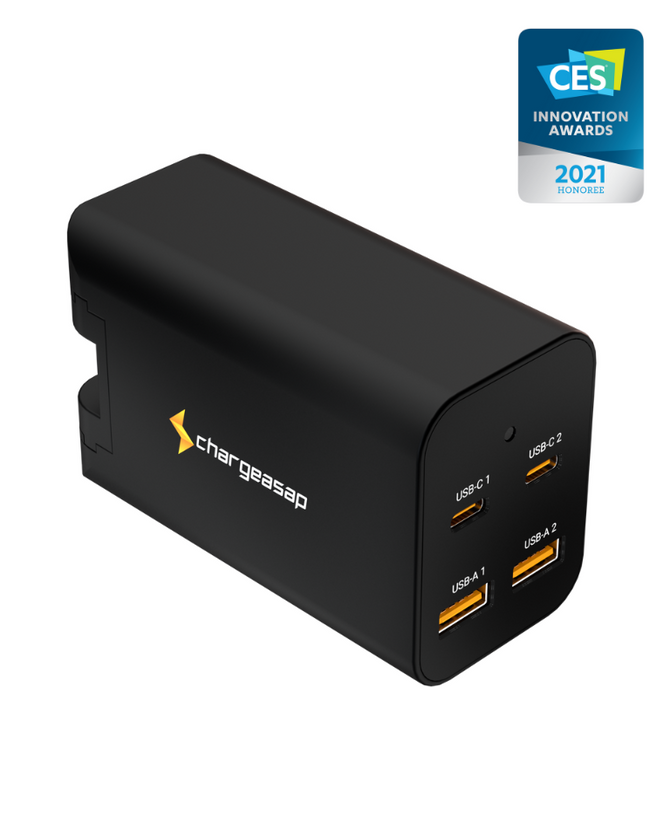
Zeus ships with interchangeable plugs covering over 150 countries. The Anker does not, so add a travel adapter at $25 to $30, and the real gap is closer to $12. You also remove an item from the bag and a loose, lightly engineered joint between the wall and a charger drawing over 100W, which is the most common cause of slow charging abroad.
If the second 140W port is what you need

Zeus 280W: two laptops, one plug
Two ports that each reach 140W when the total allows it, 280W across four ports, an OLED showing live draw, and plugs for 150+ countries in the box. 380g against the Anker's 640g.
$189 View

Omega 200W: one laptop, same travel kit
If it is one laptop plus two or three devices, this does that job for $50 less and ships with the same 150-country plug set. Cheaper than the Anker once you add the adapter the Anker does not include.
$139 View
Specifications for both chargers are taken from each manufacturer's published figures at time of writing.
When the Anker Is Enough
If you charge one laptop, the charger lives on a desk and never travels, and you want the most sockets for the money, the Anker Prime 250W is a good charger and the cheaper answer. It has six ports to our four and a larger display with a dial for setting port priority. Nothing above changes that.
Which to Buy
Buy Zeus 280W if you run two laptops or two high-draw devices at once, or the charger goes in a bag, or you travel and would otherwise be buying an adapter anyway. All three are cases where the Anker either cannot do the job or costs more than it appears to.
Buy the Anker Prime 250W if it is one laptop, on one desk, and port count matters more than size.
Buy the Omega 200W if it is one laptop but the charger still travels. It is the cheapest of the three once the Anker's missing adapter is priced in.
Vinson is Cofounder at Chargeasap, an Australian charging hardware company that has run 14 crowdfunding campaigns on Kickstarter and Indiegogo and shipped to more than 108,000 customers since 2016. Specifications for both chargers are taken from each manufacturer's published figures at time of writing.
FAQ
Can the Anker Prime 250W charge two laptops at 140W each?
Not two 140W laptops. Its C1 port delivers up to 140W and the other USB-C ports cap at 100W each, so a second large laptop charges more slowly. It will charge two smaller laptops at their full rate.
Is the Zeus 280W worth the extra over the Anker Prime 250W?
If you need two devices at 140W, yes, because the Anker cannot do it at any price. If you travel, the gap is smaller than it looks, since Zeus includes plugs for over 150 countries and the Anker does not. For one laptop on a desk that never moves, the Anker is the better value.
Does 280W mean every port gets its maximum at once?
No, and this is true of every multi-port charger. Total output is shared across connected devices. Zeus prioritises two ports at up to 140W when the total allows it, and the allocation changes as you add devices. Any charger claiming every port at maximum simultaneously is adding numbers that cannot occur together.
Which is better for travel?
Zeus, on two counts. It is 231cm³ and 380g against 395cm³ and 640g, and it ships with interchangeable plugs for over 150 countries. With the Anker you would add a travel adapter, which is another item to carry and another point of failure at high wattage.