Quick answer: First decide which kind you need. If everything you travel with charges over USB, get a USB charger with the international plugs in the box: the Omega 200W covers a laptop plus two or three devices, the Omega 100W covers a phone, tablet or MacBook Air, and the Zeus 280W covers two laptops, or a 16-inch MacBook Pro at its full 140W. If anything needs a mains socket, such as a hair dryer or a non-USB laptop brick, get a universal adapter with a live AC socket instead. The G6 65W is the only one we know of that also has enough USB-C power to charge a laptop.
Flying with it: a wall charger can go in any bag, with no limit. A power bank must go in your carry-on and, under FAA rules, stay at or under 100Wh unless your airline approves a larger one. The full rules are below.
The one most travellers should buy

Four ports, laptop-first power, and AU, EU and UK plugs in the box. Replaces the laptop brick and the adapter.
$139
★★★★★ 4.77 from 138 reviews · Free shipping over $99 · 30-day returns
Need a socket for a hair dryer? G6 65W adapter, $39
Most things sold as travel chargers are not chargers. They are plug adapters with a token USB port bolted on, and the port is there so the box can say "USB". You land in Tokyo, plug it in, and discover it will charge your phone slowly and will not touch your laptop at all. So the laptop brick comes too, and now you are carrying two things plus a converter, and one of them is the thing you actually needed.
But there is a second mistake underneath that one, and it is the reason people buy twice. Two completely different products are sold under the same name. Get the category wrong and the wattage question does not even matter.
The two kinds of travel charger
A USB charger with international plugs. It has USB-C and USB-A ports and nothing else. The plug changes to fit the country. It cannot take a two-pin appliance, because there is no socket on it to take one. This is the right buy if everything you travel with charges over USB.
A universal adapter with a live AC socket. It has a full mains socket on the front, so anything can go into it: a hair dryer, a travel iron, a camera battery charger, your partner's laptop brick that is not USB-C. The better ones also have USB-C ports. This is the right buy if even one thing in your bag does not charge over USB.
Almost every guide mixes these together and ranks them on wattage, which is like ranking cars and vans on top speed. Below they are compared as one table, but the type column is the first thing to read, not the price.
What is a travel adapter, and do you still need one?
A travel adapter changes the shape of a plug so it fits the wall socket in another country. That is all it does. It does not change the voltage, and it does not charge anything by itself.
A universal travel adapter is one block with the main plug shapes built in, usually US, UK, EU and AU, which slide or fold out as you need them. The front has a socket for your own plug, and most now add a few USB ports.
Do you still need one if your charger comes with swappable plugs? For anything that charges over USB, no. A charger like the Omega or the Zeus goes straight into the wall with the plug for that country. Your laptop, phone, tablet, watch and earbuds are covered, and there is no adapter to pack.
You do still need one for anything with its own mains plug. A swappable-plug charger has no socket on it, so there is nowhere for that plug to go.
| What is in your bag | Travel adapter needed? |
|---|---|
| Phone, tablet, watch, earbuds | No. They charge over USB. |
| A laptop that charges over USB-C | No. Pick a charger with enough watts for it. |
| A laptop with its own non-USB power brick | Yes. |
| Hair dryer, straightener or travel iron | Yes, and check it is rated 100 to 240V. |
| Camera battery charger or shaver with a mains plug | Yes. |
One honest limit. Four plug shapes cover most of the world, which is where figures like "150+ countries" come from, but they do not fit every socket. Look up the plug type for where you are going before you rely on any charger or adapter, ours included.
If you do need an adapter, pick one that can also charge your laptop. That is the G6 65W, covered below.
What actually matters
Total output, not port count. Six ports on a 65W charger is six devices sharing 65W. The number that decides whether your laptop charges while your phone is plugged in is the total wattage, and how that total is divided when several ports are in use.
How the charger splits its power. This is the part nobody tests and everybody feels. Plug a phone into a charger that divides power evenly and your laptop loses a chunk of its supply to a device that needed 20W. Chargers with laptop-first distribution protect the laptop port and share what is left. Same headline wattage, completely different experience.
Whether the plugs are in the box. "Works worldwide" usually means the charger accepts 100 to 240V, which almost every USB-C charger has done for years. That is not the same as fitting the socket. Check whether the plugs themselves are included, because a charger that needs a $30 adapter bought separately is not the price on the label.
The 2026 comparison
| Charger | Type | USB output | Live AC socket | Plugs included | Price |
|---|---|---|---|---|---|
| Chargeasap Zeus 280W | USB charger | 280W total, two ports to 140W | No | Yes, 150+ countries | $189 |
| Chargeasap Omega 200W | USB charger | 200W total, 100W laptop first | No | Yes, US prongs plus AU, EU and UK | $139 |
| Chargeasap Omega 100W | USB charger | 100W total, 3 ports | No | Yes, US prongs plus AU, EU and UK | $49 |
| Chargeasap G6 65W | Universal adapter | 65W total, 61W on USB-C | Yes | Built in, 150+ countries | $39 |
| Satechi 145W Travel Charger | USB charger | 145W total, PD 3.1 | No | Yes, 4 plug adapters | ~$150 |
| OneAdaptr OneWorld135 | USB charger | 135W total, 100W top port | No | Yes, 200+ countries | ~$100 |
| Minix Neo P3 100W | USB charger | 100W total | No | Yes, US, EU and UK | ~$80 |
| EPICKA Universal Adapter | Universal adapter | ~30W total | Yes | Built in, 150+ countries | ~$25 |
Two products in that table have a live AC socket. One of them can charge a laptop.
So before anything else, answer one question: does anything in your bag need a mains socket? A hair dryer, a travel iron, a camera battery charger, a partner's non-USB laptop brick. That answer, not the wattage, decides which half of the list you are shopping in.
Everything charges over USB

Omega 100W: phone, tablet, MacBook Air
Three ports and the same AU, EU and UK adapters in the box. The cheapest way to stop packing a separate travel adapter, and enough for an Air at its rated wattage with a phone alongside.
$49 View

Omega 200W: a laptop plus two or three things
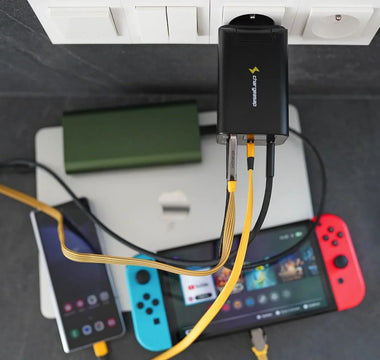
200W across four ports with laptop-first distribution, so C1 holds 100W and a phone in a spare port does not steal from it. The one most people should buy.
$139 View

Zeus 280W: two laptops, or a 16in Pro at 140W
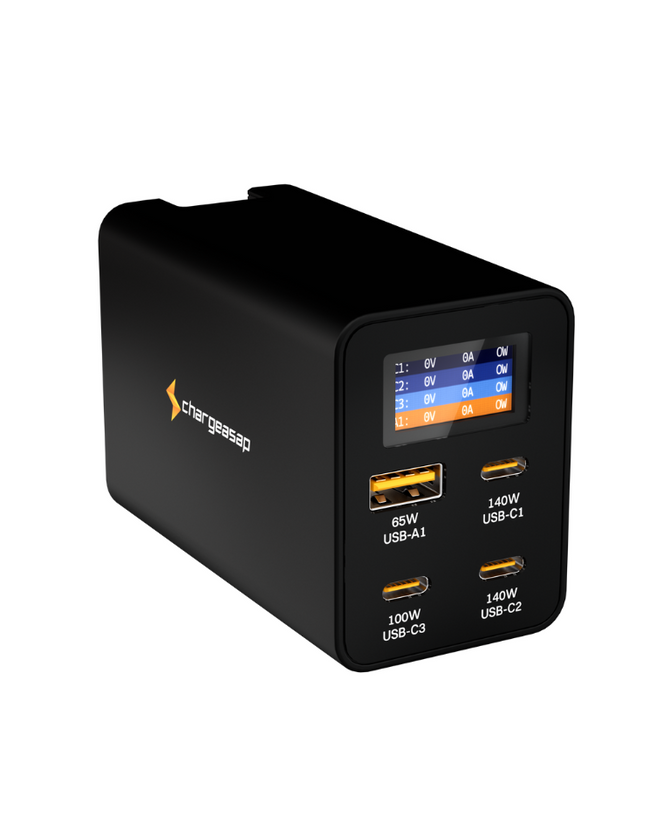
The only one here with two ports reaching 140W, so a 16in MacBook Pro charges at its maximum and a second laptop can too. 380g, with plugs for 150+ countries and a live wattage display.
$189 View
Something needs a mains socket

G6 65W: the socket, plus real USB power
A live AC socket that takes hair dryers and irons, plus 61W of USB-C PD, roughly double what the rest of the universal adapter aisle manages, and enough to run a MacBook Air at its rated wattage. Plugs built into the body, so nothing clips off in a hotel room.
$39 View
Want the socket and more USB power? The G6 Pro is the same idea at 100W for $59. Stock moves quickly, so check availability before planning around it.
Chargeasap Omega 200W: the one that replaces the laptop brick
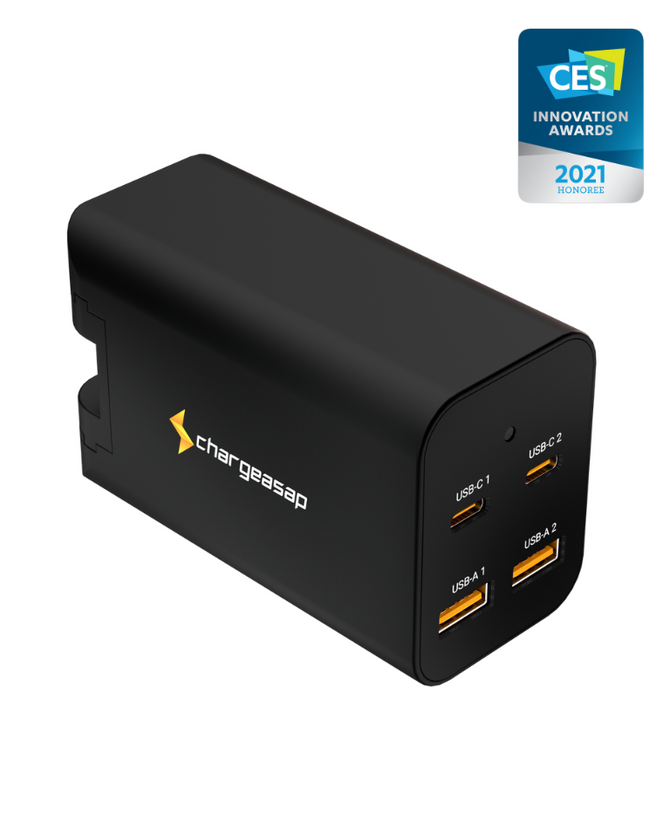
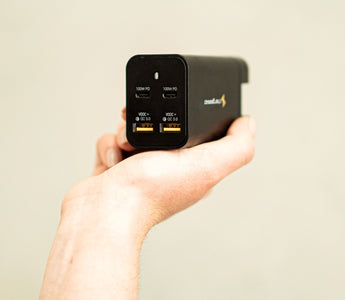
We built the Omega because we kept packing two things and resenting it. It is 200W across four ports, two USB-C and two USB-A, and it comes with three travel adapters in matching colours for AU, EU and UK on top of its own foldable US prongs. There is no separate adapter to buy and no second brick for the laptop.
The detail that matters more than the headline number is how it divides power. Omega uses laptop-first distribution, so the C1 port is prioritised at 100W and holds it. On most chargers, plugging a phone into a spare port quietly steals supply from the laptop. On this one the laptop keeps its allocation and the remaining power is shared across the other three ports. A 16in MacBook Pro, an iPad Pro, an iPhone and a pair of AirPods run off one socket, which is usually all a hotel room gives you.
Two honest limits, because a charger that claims none is lying. The 100W on C1 is not the 140W maximum a 16in MacBook Pro will accept, so that machine charges fast but not at its absolute ceiling. That is what the Zeus is for. And the 200W total is a budget, so with four devices connected each is drawing a share rather than its own maximum.
The one thing it will not do is take a hair dryer, because it has no mains socket. If that matters, the G6 is your answer instead.
Chargeasap G6 65W: the universal adapter that actually charges a laptop
This is the product most people in the market for a "travel adapter" should be looking at, and it is the one that gets overlooked because 65W sounds small next to 200W.
It is not competing with the Omega. It is competing with the EPICKA, and in that category 61W of USB-C Power Delivery with PPS is not a small number, it is roughly double what anything else offers. The entire universal adapter aisle tops out around 30W, which charges a phone and nothing more. The G6 will run a MacBook Air at its rated wattage, or a 14in MacBook Pro below its rated 96W, from the same slot that also takes your travel iron.
That AC socket is the point. It supports high wattage appliances including hair dryers, irons, heaters and kettles, so it works as the only adapter in the bag rather than an extra one. Anything that does not charge over USB still has somewhere to go.
The plugs are built into the body, so nothing clips on and nothing gets left in a hotel room. There is an LED so you can find the ports in the dark, and it is GaN rather than silicon, which is why 65W fits in something this size. At $39 it costs about the same as a decent dumb adapter that cannot charge a laptop at all.
If you want the same idea with more power, the G6 Pro steps the USB output up to 100W for $59, which is enough for a 14in MacBook Pro at close to its rated wattage with a phone alongside it. Stock on the Pro moves quickly, so check availability before you plan around it.
The alternatives, briefly
Satechi 145W Travel Charger
The strongest competitor in this set and the one worth comparing most carefully. 145W across four USB-C ports on PD 3.1, with four international plug adapters in the box, so it answers the same question the Omega does. The gap is the 55W between them, which is what your phone, tablet and earbuds share once the laptop has taken its allocation. If you carry a laptop and one other thing, it is a genuinely good buy.
OneAdaptr OneWorld135
The closest direct comparison to the Omega 200W. Real international plug coverage and a 100W top port. The difference is the 35W that is left over once a laptop is charging, against the Omega's 100W, which is what everything else in your bag has to share.
Minix Neo P3 100W
Small, well made, three plug options, and the direct rival to the Omega 100W at roughly $30 more. If you carry a MacBook Air and a phone and nothing else, it does that job. Add a tablet that also wants real power and the 100W total runs out quickly, which is true of both.
EPICKA Universal Adapter
The default choice in this category for years, and it is a competent adapter. The socket takes anything and the plug coverage is broad. The limitation is the USB side: around 30W total means a phone, or a phone and a slow tablet, and the laptop brick is still coming with you. It costs $14 less than the G6 and does roughly a third of the USB work, which is the whole comparison.
What to buy
Answer the socket question first, then match the wattage to the biggest thing you charge.
- Everything is USB, and it is a phone, tablet or MacBook Air: the Omega 100W at $49. Plugs included, so nothing else to buy.
- Everything is USB, and you carry a laptop plus two or three things: the Omega 200W. The one most travellers should buy.
- Everything is USB, and it is two laptops or a 16in Pro at 140W: the Zeus 280W. Nothing else here holds 140W on two ports.
- Something needs a socket, and you also carry a laptop: the G6 65W, or the G6 Pro if you want 100W. These are the only universal adapters with enough USB output to matter.
- Something needs a socket, and you only charge a phone: the EPICKA does that for $25.
- I want one of each: the Omega lives in the laptop bag, the G6 stays in the suitcase permanently. Together they cost less than most people spend replacing lost adapters.
Can you take a charger or a power bank on a plane?
Short version: a wall charger flies in any bag. A power bank flies in your carry-on only, and its size is capped.
Wall chargers and travel adapters. A charger is not a battery. It stores no energy, so there is no watt hour limit on it and no airline rule against packing one. You can put a 280W charger in hand luggage or a checked bag without a second thought.
Power banks. These are lithium batteries, so the rules are different. The FAA says spare lithium batteries, including power banks, "must be carried in carry-on baggage only". They cannot go in a checked bag.
| Power bank size | FAA rule |
|---|---|
| Up to 100Wh | Allowed in carry-on. No airline approval needed. |
| 101 to 160Wh | Carry-on only, with airline approval, and no more than two. |
| Over 160Wh | Not allowed. |
Those are the FAA's limits. Airlines can be stricter, and many now cap how many power banks you can bring or do not allow using or charging them during the flight. Check your airline before you fly.
To find the watt hours, look at the label. If it only shows mAh, multiply the mAh by the voltage (usually 3.6V or 3.7V) and divide by 1,000. That is why so many large power banks stop just below 27,000mAh.
A big power bank that still flies

Flash Pro Ultra, 25,000mAh
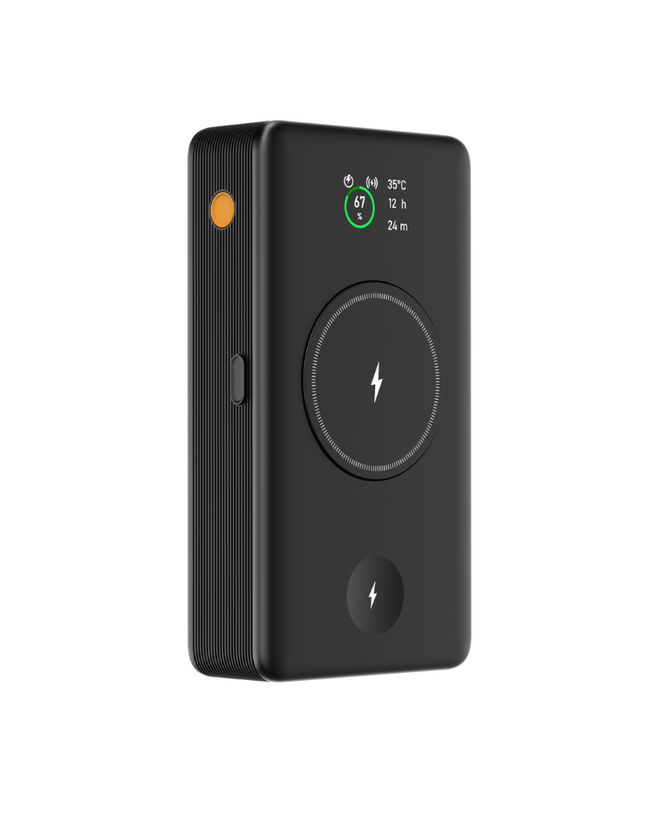
90.75Wh, so it sits under the FAA's 100Wh line and needs no airline approval. Pack it in your carry-on, not your checked bag.
$249 View
Voltage, sockets and the myth of the converter
Almost every USB-C charger sold today is rated 100 to 240V, which covers both the 110V countries and the 220 to 240V ones. That means you need an adapter to fit the socket, not a converter to change the voltage. Converters are heavy, they are for appliances with heating elements, and running a modern charger through one does nothing useful.
The important exception is the AC socket on a universal adapter. An adapter passes the local voltage straight through unchanged. So a 110V-only American hair dryer plugged into a universal adapter in a 240V country will be destroyed, adapter or not. Check that the appliance itself says 100 to 240V before you rely on it. Most modern travel hair dryers and all laptop bricks do.
Worth knowing too: some older two pin European sockets and hotel bathroom shaver sockets are current limited. A high wattage charger plugged into one of those will not be harmed, it simply will not get what it asks for. Use a proper wall socket.
Frequently asked questions
Can you take a travel charger on a plane?
Yes, in carry-on or checked baggage. A wall charger stores no energy, so airline watt hour limits do not apply to it, whatever its wattage. Those limits apply to lithium batteries such as power banks.
Can you take a power bank on a plane?
Yes, in carry-on baggage only. The FAA does not allow power banks in checked bags. A power bank up to 100Wh needs no airline approval. One between 101 and 160Wh needs airline approval, and you can carry no more than two. Airlines can set stricter limits, so check before you fly.
What is the biggest power bank you can take on a plane?
Under FAA rules, 100Wh without airline approval, which is roughly 27,000mAh. The Flash Pro Ultra is 25,000mAh and 90.75Wh, so it is under the limit.
What is a travel adapter?
A travel adapter changes the shape of a plug so it fits the wall socket in another country. It does not change the voltage. A universal travel adapter has the main plug shapes, usually US, UK, EU and AU, built into one block.
Do I need a travel adapter if my charger comes with international plugs?
Not for devices that charge over USB. The charger goes straight into the wall with the plug for that country. You still need an adapter for anything with its own mains plug, such as a hair dryer or a non-USB laptop power brick.
What is the difference between a travel adapter and a travel charger?
A travel adapter has a live mains socket, so it takes any plug including appliances, and the better ones add USB ports. A travel charger has USB ports only and changes its own plug to fit the country. If anything you carry does not charge over USB, you need the adapter type.
Can I use a hair dryer with a travel adapter?
Only if the hair dryer itself is rated 100 to 240V. An adapter changes the shape of the plug, not the voltage, so a 110V-only appliance plugged in at 240V will be damaged. Check the label on the appliance.
Do I need a voltage converter to charge my laptop overseas?
No, as long as the charger is rated 100 to 240V, which nearly all USB-C chargers are. You need a plug adapter, or a charger that includes the plugs, not a converter.
Will one charger run my laptop and my phone at their full wattage at the same time?
The total output is shared between the ports, so with several devices connected each draws less than its maximum. Chargers with laptop-first distribution protect the laptop's share, and a higher total means less compromise for everything else.
How many watts do I actually need?
A 16in MacBook Pro takes up to 140W, a 14in takes 96W, a MacBook Air takes 30 to 70W, and a phone takes 20 to 45W. Add up what you carry, then add headroom, because a charger running at its absolute limit runs hot and slow.
Vinson is Cofounder at Chargeasap, an Australian charging hardware company that has run 14 crowdfunding campaigns on Kickstarter and Indiegogo and shipped to more than 108,000 customers since 2016.