
Written by Vinson, Cofounder at Chargeasap, with 10 years building and testing portable chargers.
GaN chargers have been the dominant technology in high-performance USB-C charging for the past five years. If you have bought a charger recently, there is a good chance it uses GaN. But most product listings describe GaN as "more efficient" or "runs cooler" without explaining why. This guide covers what GaN actually is, how it differs from the silicon chargers that came before it, and why it matters for how you charge your devices.
What Is GaN?
GaN stands for Gallium Nitride. It is a semiconductor material used to build the transistors inside a charger's power conversion circuit. Before GaN, virtually all chargers used silicon transistors. Silicon has been the standard semiconductor material since the 1950s and works well, but it has physical limitations that become significant at high power levels.
Navitas Semiconductor, one of the leading GaN chip manufacturers, describes GaN as able to switch power on and off up to 40 times faster than silicon. This faster switching is the root cause of every practical benefit GaN chargers have over silicon chargers.
Why Faster Switching Matters
A charger works by rapidly switching the incoming AC power on and off to convert it to the DC voltage your device needs. The faster the switching, the smaller the components need to be to handle the same amount of power. Smaller components mean a smaller charger. Faster switching also means less energy is lost as heat during each switching cycle, which means the charger runs cooler and wastes less electricity.
In practical terms: a GaN charger delivering 100W is roughly half the size and runs significantly cooler than a silicon charger delivering the same 100W. This is not a marginal improvement. The 96W Apple MacBook Pro charger released in 2019 was the size of a large bar of soap. A GaN charger delivering the same wattage today fits in a shirt pocket.
GaN vs Silicon: The Key Differences
| Silicon Charger | GaN Charger | |
|---|---|---|
| Switching speed | Slower | Up to 40x faster |
| Size at equivalent wattage | Larger | Significantly smaller |
| Heat generated | More | Less |
| Energy efficiency | Lower | Higher |
| Maximum practical wattage | ~65W before size becomes impractical | 280W+ in a compact form factor |
Does GaN Charge Faster?
GaN itself does not make charging faster. What it does is make it practical to build chargers with much higher wattage in a small, cool-running form factor. The charging speed comes from the wattage, not the GaN technology directly.
A 30W GaN charger charges your phone at the same speed as a 30W silicon charger. The GaN version is just smaller and cooler. Where GaN makes a real difference is at higher wattages: a 140W GaN charger that fits in your bag is practical. A 140W silicon charger would be the size of a brick and too hot to leave on a desk.
What to Look for in a GaN Charger
Not all GaN chargers are equal. The GaN chip is one component inside the charger. The quality of the other components, the power distribution circuit, and the thermal management all determine how well the charger performs in practice.
The most important spec to check is the power distribution table: how much wattage does each port deliver when multiple ports are in use simultaneously? Many chargers advertise a high total wattage but throttle individual ports significantly when more than one device is connected. A charger that delivers 140W on Port 1 regardless of what is connected to the other ports is a fundamentally different product from one that drops to 65W on Port 1 when Port 2 is in use.
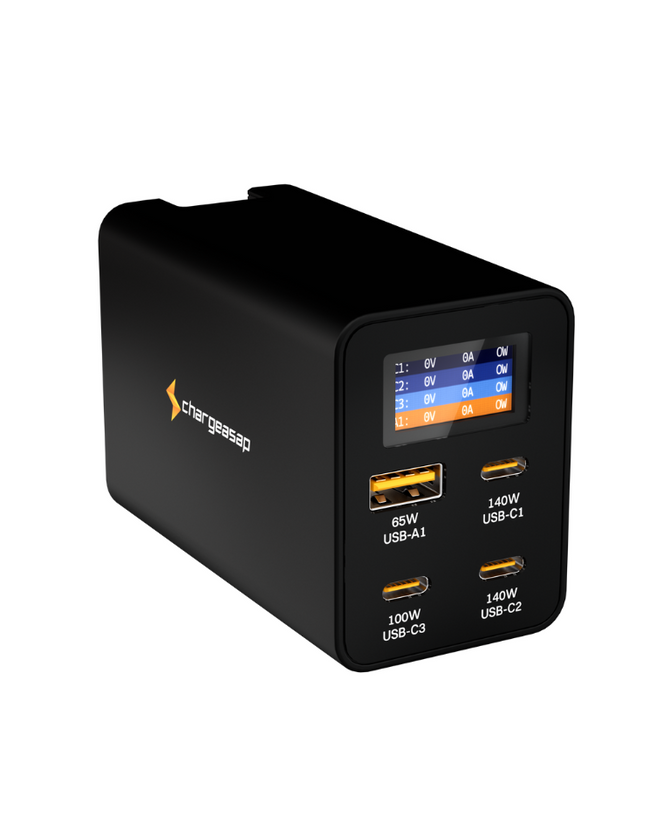
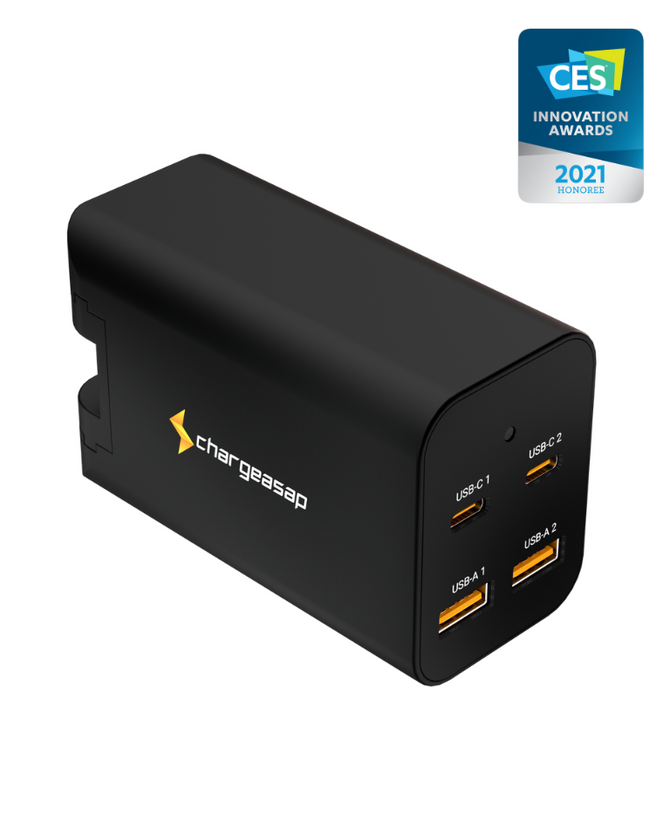
Our Zeus 280W GaN Charger uses Navitas GaNFast technology and delivers 140W on Port 1 regardless of what is connected to the other three ports. The built-in OLED display shows the live wattage on each port so you can verify this yourself. 5,064 people backed it on Kickstarter, and 9,400+ more backed it on Indiegogo, which reflects the demand for a charger that actually delivers on its wattage claims.
"…it has performed as stated. Being able to charge my MacBook Pro, iPad Pro and iPhone from the one device and at full speed is awesome."
- Wayne E., verified buyer
Shop Chargeasap GaN chargers here.
Vinson is Cofounder at Chargeasap, an Australian charging hardware company that has run 14 crowdfunding campaigns on Kickstarter and Indiegogo and shipped to more than 108,000 customers since 2016. He has personally tested every GaN charger in this guide.
FAQ
What does GaN mean in a charger?
GaN stands for Gallium Nitride, a semiconductor material used to build the transistors inside a charger's power conversion circuit. GaN transistors switch up to 40 times faster than traditional silicon transistors, which allows GaN chargers to be significantly smaller, run cooler, and handle higher wattages than silicon chargers of the same size.
Is a GaN charger better than a regular charger?
Yes, at higher wattages. A GaN charger delivering 65W or more will be noticeably smaller and cooler-running than a silicon charger at the same wattage. At lower wattages (under 30W), the size difference is less significant. For laptop charging or multi-device charging, GaN is the clear choice.
Are GaN chargers safe?
Yes. GaN technology is well-established and used in chargers by Apple, Anker, and other major brands. The safety of a charger depends on the quality of all its components and its certifications (UL, CE, FCC), not the semiconductor material alone. A GaN charger from a reputable brand with proper certifications is as safe as any quality silicon charger.
Do GaN chargers work with all devices?
Yes. GaN chargers use the same USB-C Power Delivery standard as silicon chargers. Any device that charges via USB-C is compatible with a GaN charger. The GaN technology is inside the charger and is invisible to the device being charged.